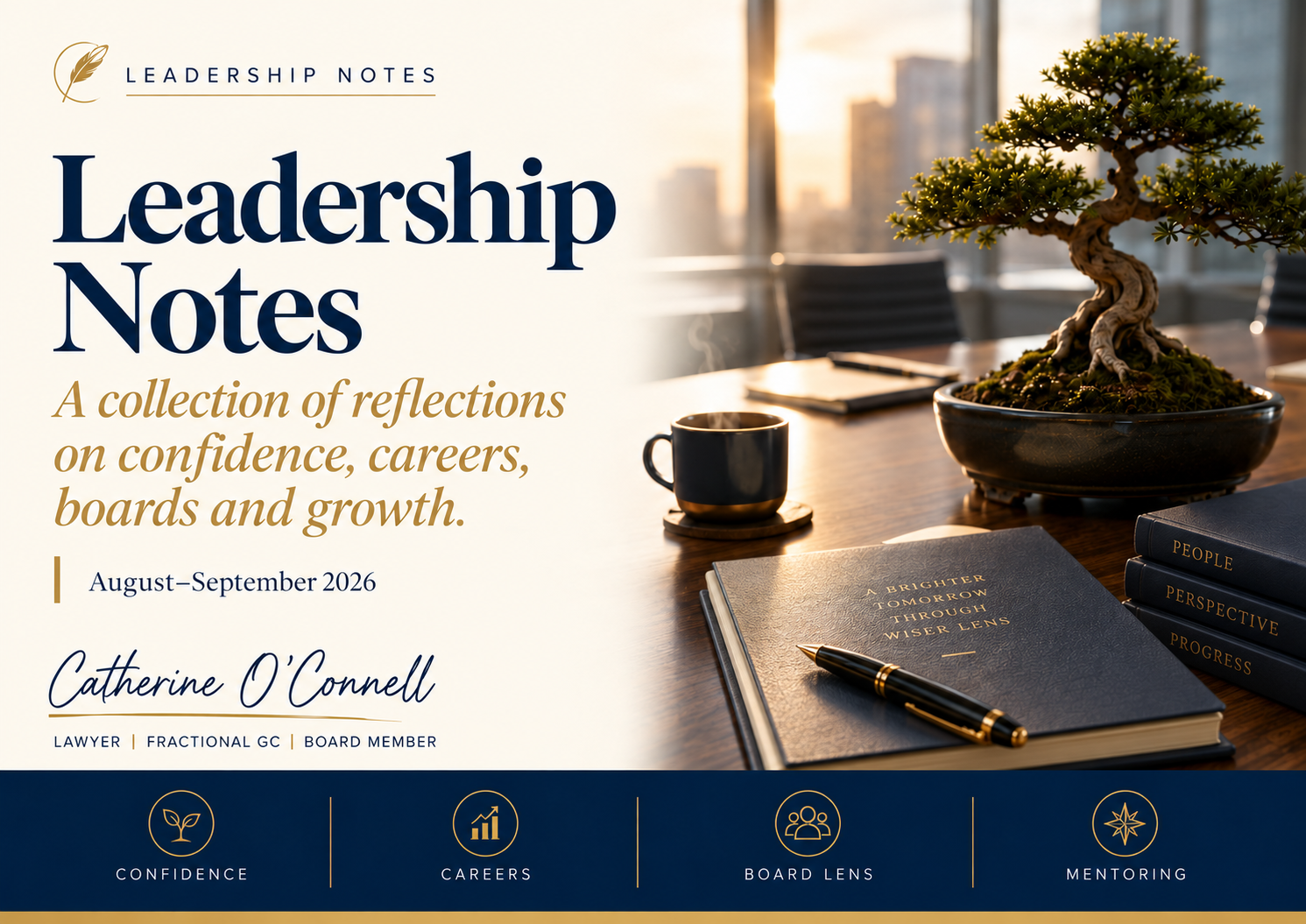
Leadership Notes — August into September
Over August I started experimenting with something new: a series of short Leadership Notes drawn from my own career, board work, mentoring conversations and the questions I find myself returning to. What began as a test has started to develop its own rhythm — and even its own visual language, with navy, gold and the bonsai becoming recurring motifs for accumulated experience, patient growth and perspective.
1. Confidence is what evidence gives you afterwards
The first note began with a realisation after three prospective-client conversations. I found myself wishing I could have explained my practice in 2018 as confidently as I can today. Of course I could not: in 2018 I had conviction, but I did not yet have eight years of evidence.
The central idea became: confidence is not the price of admission; it is the reward for accumulating evidence. Clients returning, referrals, difficult questions becoming easier to answer, and recognition from peers all gradually built the evidence behind the confidence.
This note also became the seed for what I am calling The Confidence Framework: conviction leads to action; action creates evidence; evidence builds confidence; external validation often comes later.
The image: A bonsai beside a notebook and coffee, in the new navy-and-gold palette, carrying the line: “We often think confidence comes first. I have come to believe it is the other way around. Confidence is what evidence gives you afterwards.” It was the image that first made the bonsai feel like more than decoration — it began to represent the quiet accumulation of strength over time.
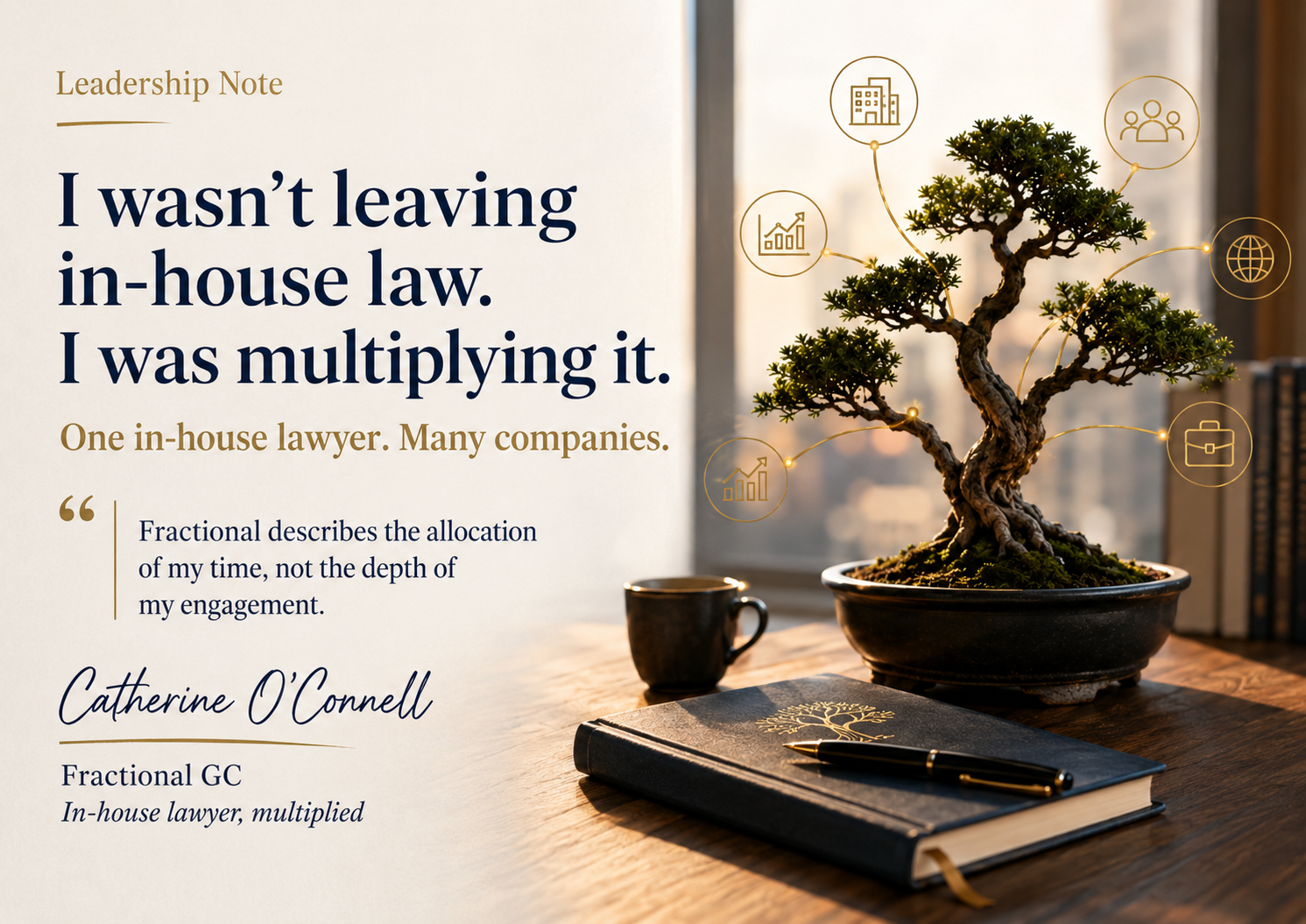
2. I was not leaving in-house law. I was multiplying it.
This note explained the thinking behind establishing my own practice in 2018. I was not seeking freedom from in-house life. I had identified a gap: companies often needed experienced in-house legal judgement without needing a full-time General Counsel.
The idea was remarkably simple: one in-house lawyer, many companies.
It also helped me articulate what “fractional” means to me. Fractional describes the allocation of my time, not the depth of my engagement. I may give a company part of my time, but while I am working with that business, the objective remains a genuinely in-house one: understanding its people, priorities, risks and decision-making rhythm.
The image: Again centred around the bonsai, with the headline “I was not leaving in-house law. I was multiplying it.” The supporting line, “One in-house lawyer. Many companies,” captured the model more simply than any technical definition of Fractional GC.
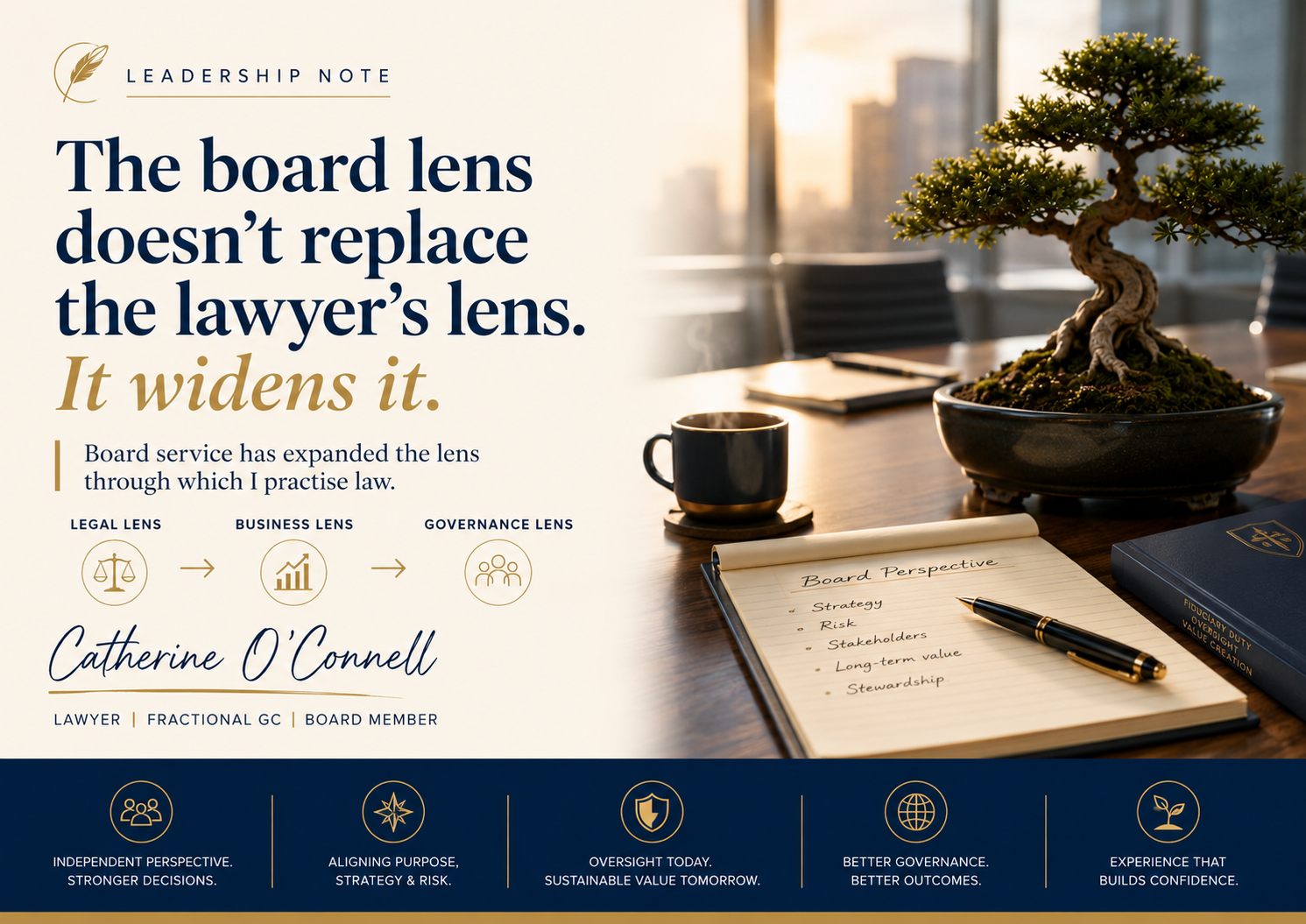
3. The board lens does not replace the lawyer’s lens. It widens it.
Board service has changed the way I practise law. I still ask the legal question, but increasingly it sits inside a broader governance lens.
The note explored the progression from “Is this legally sound?” to “Will this work for the business?” and then “What does this mean for the organisation as a whole?”
Recent questions from prospective fractional clients brought this into focus. They were asking for someone who could participate upstream in strategic discussions, identify enterprise-level risk, understand governance and accountability, and contribute commercial judgement rather than simply review contracts once the business decisions had already been made.

My conclusion was simple: I still have my legal brain switched on. I just no longer ask the legal question in isolation.
The image: A boardroom setting with the bonsai and the progression Legal Lens → Business Lens → Governance Lens, reinforcing visually how board service has expanded rather than replaced the lawyer perspective.
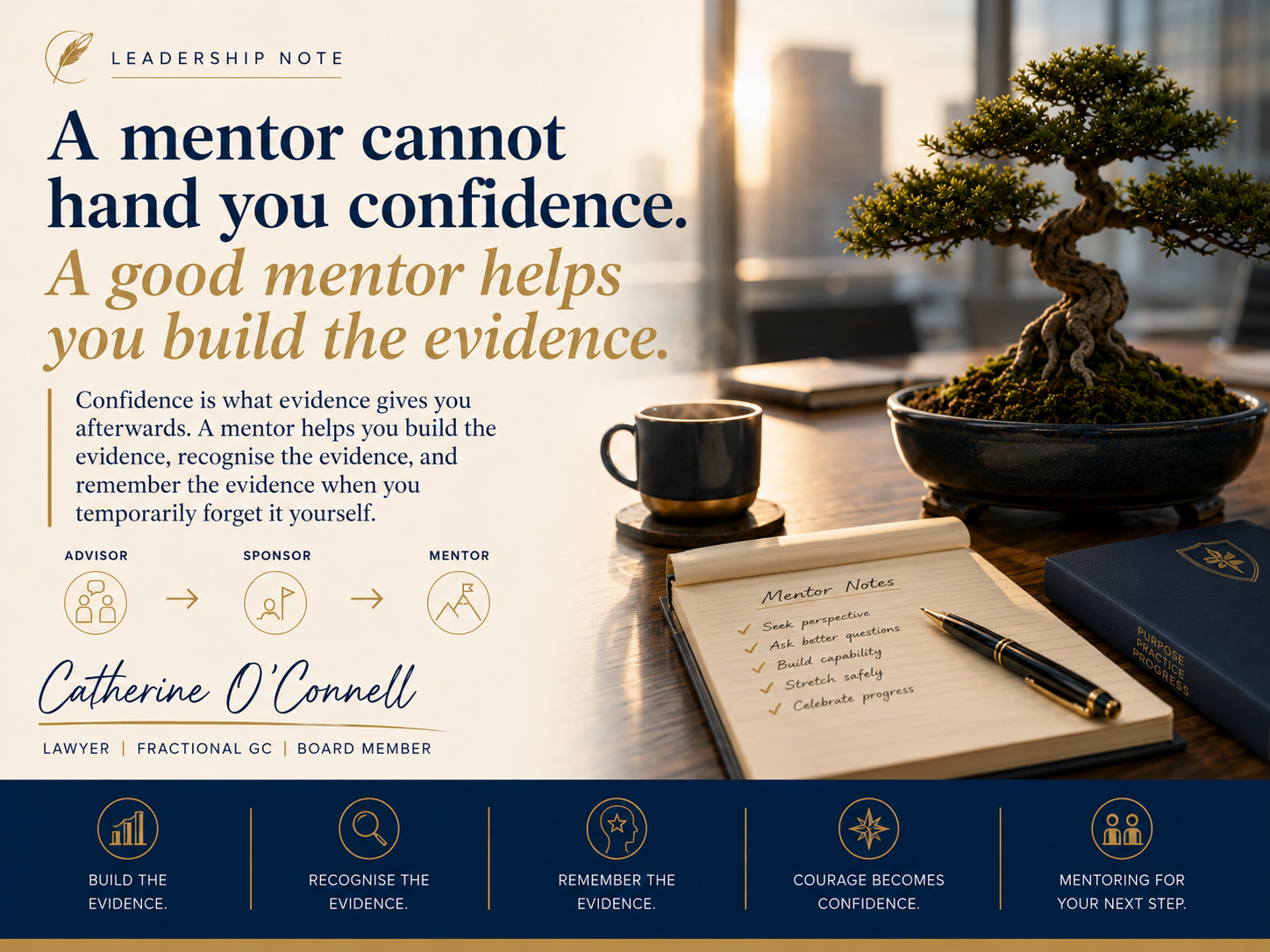
4. A mentor cannot hand you confidence. A good mentor helps you build the evidence.
This note returned to the Confidence Framework from another direction: mentoring.
Advisors, sponsors and mentors all play important roles in a career, but mentoring provides something distinctive. A good mentor understands enough of the broader career picture to help someone recognise what they already have, identify what still needs to be built, and give honest perspective when the person cannot see the situation clearly themselves.
The phrase that became central was:
Build the evidence. Recognise the evidence. Remember the evidence.
A mentor cannot transfer confidence to another person. They can help the mentee gather and recognise the evidence on which their own confidence can eventually rest. That is how courage gradually becomes confidence.
The image: The bonsai returned alongside the headline “A mentor cannot hand you confidence. A good mentor helps you build the evidence.” The navy-and-gold footer captured the sequence: build, recognise, remember — and courage becomes confidence.
5. Career differentiation, not reinvention
In mentoring conversations, I frequently hear people at a career crossroads say, “I have to reinvent myself.”
I have become increasingly wary of that word. Reinvention suggests changing yourself into something else. Most experienced professionals already possess years of judgement, relationships, knowledge, leadership experience and perspective. The more useful exercise is often to distill what is already there, recognise the hidden value and bring it forward.
Sometimes an experience someone treats as incidental — an overseas assignment, an unusual role, a particular skill — turns out to be one of the things that most differentiates them.
One phrase from the note captured this:
The experience you have been treating as a supporting actor may deserve a leading role in what comes next.
The image: A simplified bonsai visual headed “Career differentiation, not reinvention.” The supporting-actor/leading-role line became the principal message, reinforcing the idea that career development can be about recognising value already present rather than creating an entirely new identity.
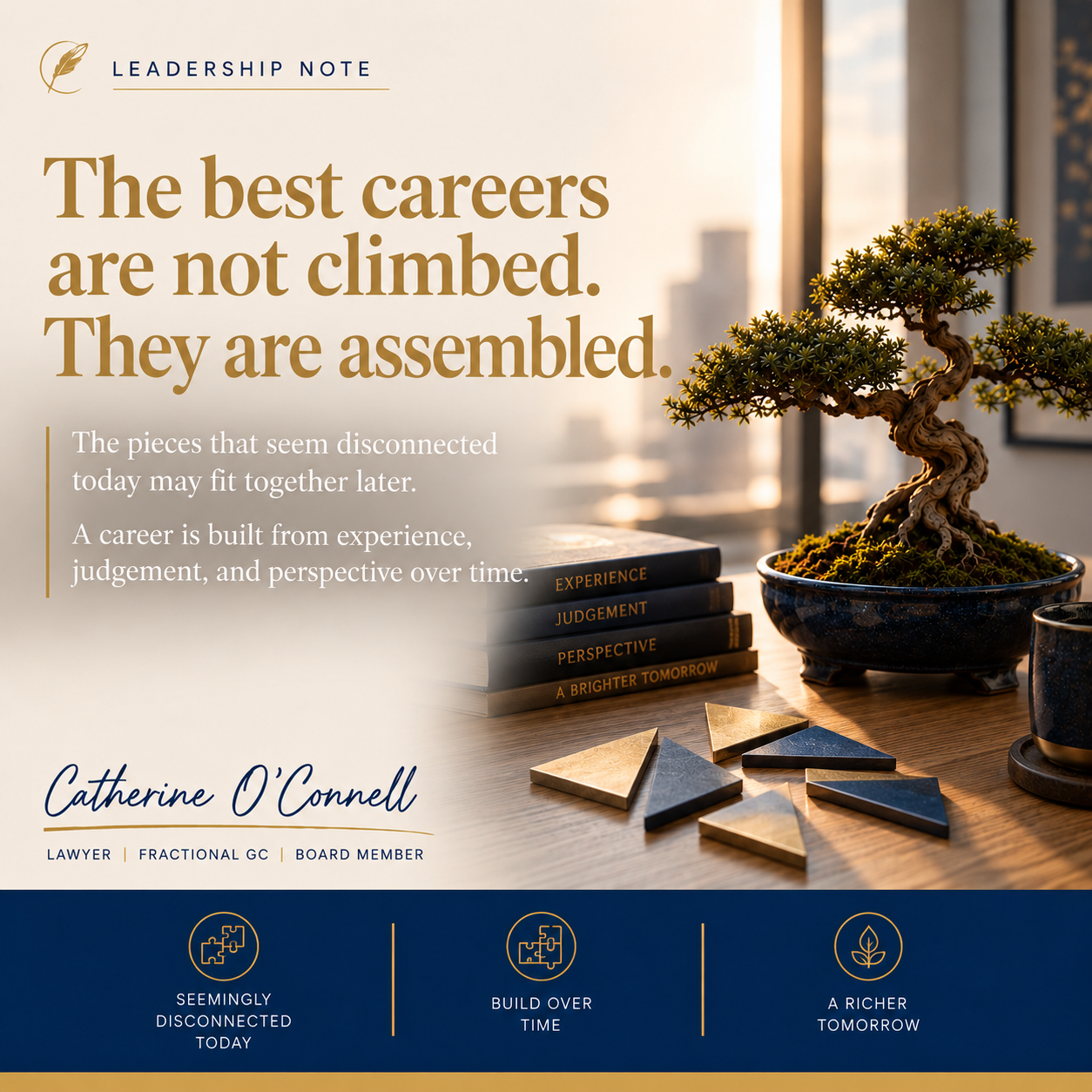
6. The best careers are not climbed. They are assembled.
For decades we have talked about the “career ladder,” but many long careers do not resemble ladders at all.
A move to another country, a secondment, a professional qualification, a difficult assignment, a side project, building something from scratch, writing, mentoring or taking a board role may appear disconnected while they are happening. Only later do we see how they combine.
Looking back at my own career, Japanese language study led to working with Japanese clients in New Zealand; that helped make Japan possible; private practice fed into in-house work; in-house experience eventually became the foundation of my own practice; and board service now feeds back into the legal and governance perspective I bring to clients.
Each stage built on the ones before it.
Some experiences that feel peripheral at one stage of a career become central much later. The finished picture is rarely visible while we are assembling it.
The image: The familiar bonsai accompanied this time by small geometric pieces — a visual suggestion of a career being assembled rather than climbed. The headline was “The best careers are not climbed. They are assembled.” The graphic reinforced the idea that apparently disconnected pieces can eventually form something coherent.

What is emerging
Looking across the six notes, I can see themes beginning to connect with my writing:
Evidence builds confidence.
Experience compounds.
Board service widens perspective.
Mentoring helps us see what we cannot see ourselves.
Careers are differentiated by combinations rather than individual credentials.
… and those careers are assembled over time rather than climbed in a straight line.
The bonsai I created and planted in March 2026, has unexpectedly become a fitting symbol for all of this too. A bonsai does not become strong overnight. Much of the work happens cultivating roots, storing energy, pruning, shaping and preparing for the season ahead. This feels a whole lot like leadership and careers as well.
- Catherine